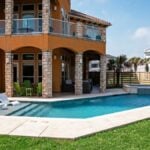
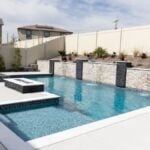
Your pool deck takes more abuse than almost any surface on your property. Sun, chlorine, foot traffic, and standing water all work against it at once. Pick the wrong material and you’re looking at cracks, stains, or a surface too hot to stand on by July.
We’ll walk you through the 10 materials homeowners and contractors reach for most, what each one costs, and how to match the right one to your yard.
What Is Pool Decking?
Pool decking is the hardscape area that surrounds your pool. Some call it the pool surround, the pool patio, or just the pool deck.
It’s where you set up lounge chairs, walk from the house to the water, and let the kids run around after a swim. Your deck shape and size usually follow the pool itself, so if you haven’t settled on a layout yet, it’s worth reviewing the different inground pool types before you lock in a decking plan.
A good deck does three jobs: it keeps mud and debris out of the pool, it gives your feet solid footing when wet, and it ties the whole backyard together.
Pool Decking vs. Pool Coping
Coping is the material capped directly on the edge of the pool shell, right where the deck meets the water. Decking is everything beyond that edge. Coping usually gets a rounded, non-slip profile because it takes the most water and bare-foot traffic on the whole deck. Many homeowners match their coping and decking materials for a seamless look, but you don’t have to.
Coping and decking are usually poured or set during the same phase of the build, so it helps to understand the full installation process before you finalize either one.
Quick Comparison of Pool Decking Options
Here’s how the 10 most common decking materials stack up before we get into the details.
| Material | Best For | Luxury Look | Heat Comfort | Slip Resistance | Maintenance | Cost Level |
|---|---|---|---|---|---|---|
| Concrete | Budget-conscious builds | Low-Mid | Fair | Good (textured) | Low | $6 – $18 |
| Stamped Concrete | Decorative look, lower budget | Mid | Fair | Good | Moderate | $14 – $22 |
| Pavers | Repairable, long-lasting decks | Mid-High | Good | Good | Low-Moderate | $16 – $28 |
| Travertine | Hot climates, luxury pools | High | Excellent | Excellent | Moderate | $25 – $50 |
| Natural Stone | High-end, one-of-a-kind decks | High | Good-Excellent | Good | Moderate-High | $15 – $40 |
| Porcelain Tile | Modern, low-maintenance decks | High | Good | Good (textured) | Low | $28 – $52 |
| Brick | Traditional, classic style | Mid | Fair | Good | Moderate | $10 – $30 |
| Wood | Above-ground pools, rustic style | Mid | Fair-Good | Fair (wet) | High | $25 – $40 |
| Composite | Low-maintenance wood look | Mid-High | Fair* | Good | Good | $35 – $75+ |
| Turf / Mixed | Small yards, play areas | Mid | Good | Good | Good | $12 – $30 |
Of Note: Newer “cool-touch” composite boards perform better in direct sun than standard composite.
Choose the Right Pool Decking for Your Home
Compare materials, costs, and design options based on your pool, yard, and budget.
10 Best Pool Decking Options for Inground Pools
Here’s a closer look at each material, what it costs, and where it holds up best.
1. Concrete Pool Decking

Poured concrete is the most common pool deck material in the country, and for good reason. It’s affordable, it can be shaped to fit any pool, and a broom or knockdown finish gives you slip resistance without much upkeep.
Installed cost typically runs $6 to $18 per square foot, depending on finish and region. Plain gray concrete gets hot in direct sun, so a light color or a cooling topcoat is worth it in hot-sun markets like Florida, Texas, Arizona, and Southern California.
If your deck is original to the pool and starting to crack or fade, it’s worth comparing that against pool resurfacing cost before you decide whether to repair or replace it.
2. Stamped Concrete
Stamped concrete is poured concrete pressed with a pattern before it cures, so you get the look of stone, brick, or tile at a lower cost. It runs about $14 to $22 per square foot installed.
The stamped texture also helps with grip. The tradeoff is that color and pattern fade over 5 to 8 years and need resealing to stay sharp.
3. Concrete Pavers

Pavers are individual units set on a compacted base, usually running $16 to $28 per square foot installed. If one paver cracks or stains, you pull it and drop in a new one instead of tearing out the whole deck.
Sand joints between pavers drain well, which matters around a pool. They do need re-sanding every few years to stop weeds and shifting.
4. Travertine Pool Decking

Travertine is natural limestone, and it’s the material we point hot-climate homeowners toward first. Its porous surface stays noticeably cooler underfoot than concrete or tile, often 20 to 35 degrees cooler at the surface on a sunny afternoon.
Expect to pay $25 to $50 per square foot installed. It needs annual sealing to resist pool chemical stains, and it’s heavy enough to require a solid base. For a luxury deck anywhere in the network’s hot-sun markets, from Florida to Texas to Arizona, it’s hard to beat.
5. Natural Stone Pool Decking

Flagstone, coral stone, and other natural stone options give you a one-of-a-kind deck since no two slabs look alike. Coral stone is especially popular in Florida for its natural grip and weather resistance.
Costs run $15 to $40 per square foot depending on the stone, with premium cuts pushing higher. It’s durable and long-lasting, but plan for more upkeep than concrete or porcelain.
6. Porcelain Tile Around Pools

Outdoor-rated porcelain pavers are dense, non-porous, and resist chlorine, salt, and staining better than almost anything else on this list. Textured finishes keep them from getting slick when wet.
Installed cost runs $28 to $52 per square foot, making it one of the pricier options. In return, you get a deck that barely needs maintenance and holds its color for decades.
7. Brick Pool Decking
Brick gives a traditional, classic look that fits older or colonial-style homes. It runs $10 to $30 per square foot installed and holds up well to weather and everyday wear.
Like pavers, individual bricks can be swapped out without disturbing the rest of the deck. The main downside is that brick can get slick with algae growth if it isn’t sealed and cleaned regularly.
8. Wood Pool Decking
Wood decking is most common around above-ground pools or homes going for a rustic look. Pressure-treated pine runs $25 to $40 per square foot installed and is the cheapest wood option, while hardwoods like ipe cost more.
Wood needs regular sealing to handle pool splash-out. Skip the sealing and you’re looking at swelling, splintering, and board replacement within 5 to 7 years.
9. Composite Pool Decking
Composite decking gives you the look of wood without the splinters, warping, or annual sealing. It resists chlorine and saltwater splash far better than real wood.
Installed cost runs $35 to $75 or more per square foot, with newer cool-touch composite boards near the top of that range. It costs more upfront, but you’re not buying stain and sealer every year.
10. Artificial Turf and Mixed Materials
Artificial turf works well as a border material or transition zone around small decks, play areas, or tight side yards where poured materials are hard to fit. It stays cooler than pavers or tile and drains well with proper base prep.
Most homeowners mix turf with concrete, pavers, or stone rather than covering the whole deck in it. Combined material costs vary widely, generally landing in the $12 to $30 per square foot range.
Which Pool Decking Material Stays Coolest?
If your pool sits in full sun most of the day, surface temperature should drive your material choice. Light-colored travertine is the top performer. Its porous structure releases heat through evaporation, so it stays comfortable even at midday.
Light concrete finishes and light-toned natural stone come in next, especially with a textured coating that reflects sun instead of absorbing it. Shade from a pergola, umbrella, or covered lanai helps any material stay cooler.
Dark pavers, dark tile, and standard composite boards absorb heat and can get too hot for bare feet in peak summer sun. If you’re set on a darker material, plan for shade over the main walking paths.
Which Pool Decking Is Least Slippery?
Slip resistance comes down to texture, not just material. A glossy or polished surface is a hazard around a pool no matter what it’s made of.
Textured concrete, travertine, and other natural stones with a honed or tumbled finish all perform well when wet. Outdoor-rated porcelain with a textured finish and pavers with a rougher surface hold up too.
Avoid polished stone or glossy tile anywhere near the water. If a showroom sample feels smooth and shiny dry, it will feel worse wet.
Pool Decking Costs by Material

These ranges cover materials and installation, but your final price depends on local labor rates, base prep, drainage needs, and design complexity.
Also, decking is just one line item. See our full inground pool cost breakdown if you’re budgeting the whole project.
| Material | Installed Cost (per sq. ft.) | Cost Level |
|---|---|---|
| Basic Concrete | $6 – $18 | Lower cost |
| Stamped Concrete | $14 – $22 | Mid-range |
| Concrete Pavers | $16 – $28 | Mid to high |
| Travertine | $25 – $50 | High |
| Natural Stone | $15 – $40 | High to premium |
| Porcelain Tile | $28 – $52 | High to premium |
| Brick | $10 – $30 | Mid |
| Wood | $25 – $40 | Mid to high |
| Composite | $35 – $75+ | High to premium |
| Turf / Mixed | $12 – $30 | Mid |
Get quotes from at least two local contractors before you commit to a material. Ask each one to break out base prep and drainage costs separately.
Know What Your Pool Deck Will Cost
Get a detailed estimate based on your decking material, project size, and installation needs.
How to Choose the Best Pool Decking for Your Yard
The right pick usually comes down to your climate, your yard size, and who’s using the pool. Here’s how to match a material to your situation.
For Hot, Sunny Backyards
Go with light-colored travertine, light concrete, or light natural stone. Add shade over the areas where people walk and sit most.
For Luxury Outdoor Living Spaces
Travertine, natural stone, and large-format porcelain give you the high-end look most luxury pool owners want.
For Lower Maintenance
Porcelain tile and quality pavers need the least upkeep. Skip wood unless you’re ready for annual sealing.
For Small Backyards
Simple concrete or large-format pavers and tile make a small space feel bigger. Busy patterns and small units make it feel cluttered.
For Families With Kids
Prioritize slip resistance and heat comfort over looks. Textured concrete, travertine, and textured pavers are the safest picks for bare feet.
Pool Decking Mistakes to Avoid
- Choosing a dark material for a deck that sits in full sun all day
- Picking a glossy or polished finish anywhere near the water
- Skipping proper drainage and base prep to save money upfront
- Matching coping and decking without checking how each handles pool chemicals
- Ignoring local permit and setback requirements before pouring or installing
- Choosing wood without a plan for annual sealing and maintenance
- Going with the lowest bid without checking base prep and drainage details
Plan Your Pool Deck the Right Way
Get expert guidance on materials, drainage, installation, and the best fit for your backyard.
Best Pool Decking Options by Goal
| Goal | Best Material(s) |
|---|---|
| Best luxury look | Travertine or natural stone |
| Best modern look | Large-format concrete or porcelain |
| Best budget option | Broom-finished concrete |
| Best repairability | Pavers |
| Best for hot climates | Light travertine or textured light concrete |
| Best low-maintenance look | Porcelain or quality pavers |
| Best for small pools | Simple concrete, large pavers, or travertine |
Ready to plan your pool deck? The right decking material comes down to your climate, your budget, and how much upkeep you want to take on long-term. If you’re still weighing options, connect with your local team for a recommendation based on your yard and region’s weather.
FAQs
What is the best material for pool decking?
There’s no single best material. It depends on your climate, budget, and how much maintenance you want to take on. For most homeowners, travertine or porcelain tile hits the best balance of looks, comfort, and durability.
How wide should a pool deck be?
Most inground pool decks run 4 to 6 feet wide on the sides and 8 to 10 feet at the main entertaining area, though local setback rules and lot size often set the real limit. Talk to your local team before finalizing dimensions.
Is concrete or pavers better around a pool?
Concrete costs less upfront and installs faster, making it the more budget-friendly choice for most projects. Pavers cost more but are easier to repair since you replace individual units instead of the whole deck, and they tend to last longer overall.
Is travertine good for pool decking?
Yes. Travertine stays cool underfoot even in direct sun, resists slipping, and holds up well outdoors for decades. The tradeoff is upkeep. It needs annual sealing to prevent pool chemicals from staining the porous surface.
Do I need a permit for a pool deck?
In most areas, yes, especially if the deck is attached to a new pool build or exceeds a certain height or size. Requirements vary by city and HOA, so check with your local building department before you pour or install anything.
How much does pool decking cost?
Most homeowners pay between $6 and $75 or more per square foot installed, depending on material. Basic concrete sits at the low end; porcelain and composite sit at the high end.
Ready to Plan Your Pool Deck?
Get help choosing the right material, design, and budget for your pool and backyard.