
Types of Inground Pools
Everything you need to know about gunite, fiberglass, and vinyl liner pools: costs, construction, lifespan, and which type is right for your backyard. From a team that builds 1,100+ luxury pools every year.
1,100+ luxury inground pools built every year | Serving 11 cities across FL, VA, NC, SC, TX, AZ & CA
When it comes to inground pools, you have three options: gunite (concrete), fiberglass, and vinyl liner. Each is built differently, priced differently, and maintained differently. What will work the best for you? Depends on your budget, design goals, timeline, and how long you’re planning to own the house.
This guide breaks down what actually separates the different pool types, breaking down how each is built, how they perform over the years, what they cost, and if there are any scenarios where one should be preferred over the other.
All this so you can confidently walk into a contractor conversation knowing exactly what to ask and what to expect.
Inground Pool Types at a Glance
Not sure where to start? Here’s a quick overview showing how gunite, fiberglass, and vinyl liner compare before we dig deeper into each type.
| Pool Type | Cost Range | Best For | Timeline |
|---|---|---|---|
| Gunite | $50,000 to $200,000 | Custom-made designs, long-term owners, luxury | 3 to 6 months |
| Fiberglass | $55,000 to $130,000 | Low maintenance, fast installation | 4 to 8 weeks |
| Vinyl Liner | $40,000 to $90,000 | Cold climates, budget conscious buyer | 4 to 8 weeks |
Gunite Pools (Concrete Pools) – Most Customizable
This is your gold standard for luxury inground pools. They’re built entirely on-site from steel-reinforced concrete, meaning, you can shape, size, and finish the pool in virtually any way you like. And that’s precisely why they are the go-to choice for homeowners who want a truly one-of-a kind backyard centerpiece for a lifetime to come.
How Gunite Pools Are Built
Gunite pools start with proper site excavation. Then a custom steel rebar framing shaped to the pool’s exact design is placed in the space and high-pressure pneumatic equipment sprays a mixture of dry cement and sand (gunite) over this framework. This creates a dense, rock-solid shell that is left to cure.
Once done, the shell receives a finish of the homeowner’s choice (it’s typically plaster, quartz, or pebble) along with waterline tile, decking, and coping. This entire process generally takes three to six months based on location, size, and scale of the overall project.


Gunite Pool Cost
Gunite pools typically run from $50,000 to $200,000, depending on the size, shape, and finish selections. If you’re going for elaborate features like vanishing edges, raised spas, grottos, etc., it’s going to raise the costs to the higher end.
As for ongoing costs, the pool will need resurfacing every 10 to 25 years based on the type of interior finish, which costs $10,000 to $30,000+. Some owners also opt for acid washing every three to five years to remove stubborn stains and extend the finish’s lifespan. This ranges from $500 to $1,500.
Despite higher upfront costs, a well-maintained gunite pool can last 50+ years. With periodic resurfacing, the structural lifespan is effectively unlimited.
To learn more about inground pool costs, check out our complete pool cost guide.
Gunite Pools Pros
- You have unlimited design flexibility, get any shape, depth, size, or feature you want and it can easily be incorporated into the build.
- They have the strongest structural integrity of any pool type as the concrete shell won’t flex, crack structurally, or shift under normal ground movement.
- Exceptional longevity. A well-maintained gunite pool lasts 50+ years with periodic resurfacing.
- You can include all kinds of luxury features. From vanishing edges, sunken fire pits, tanning ledges, grottos, custom spa integrations, and more.
- They have the highest resale value and strongest curb appeal impact of any inground pool type.
- Interior finish can be updated over time. You have the flexibility to go for plaster, pebble, quartz, or tile the entire pool.
- Gunite pools can be built on any lot regardless of slope, soil type, or access constraints that would otherwise limit prefabricated shells.
- You can use a wide variety of coping, tile, and deck materials because they’ll integrate almost seamlessly with any architectural style.
Gunite Pools Cons
- Typically the highest upfront cost of the three pool types, with significant additional spend for features and finishes. The South and West US regions are least costly.
- It has the longest construction timeline, you can expect three to six months from groundbreaking to first swim.
- Porous surface requires more chemical maintenance to prevent algae growth and maintain water balance.
- Resurfacing is required every 10 to 25 years, adding $10,000 to $30,000+ in recurring lifetime costs.
- Higher ongoing chemical usage increases operating costs versus the non-porous fiberglass surface.
Who Gunite Is Best For
Gunite is the right choice for you if you plan to stay in the house long-term and want a fully custom pool.
It’s the best option for luxury properties, large lots, or projects with complex shapes and multi-level designs. If design is non-negotiable and budget allows, gunite actually delivers results no other pool type can match.
Fiberglass Pools – Great Value and Easiest to Maintain
Over the past decade, fiberglass pools have gained significant popularity for all the right reasons. The install is much faster, requires fewer chemicals, and has lower long-term maintenance than concrete. They are factory-manufactured to precise standards, so fiberglass pools have a smooth, comfortable surface that families love, especially those with young children.
They are a smart choice for most homeowners who want quality without complexity.
How Fiberglass Pools Are Built
Fiberglass pools are manufactured off-site in a controlled factory environment. Layers of fiberglass mat and resin are built up over a mold to create a rigid, one-piece shell. This finished shell is then transported to the pool site, where an excavated hole is prepared with a sand or gravel base.
When choosing your fiberglass shell, it is very important to understand the manufacturer’s structural and gel coat warranties. This will give you strong insight into the quality of the shell when comparing manufacturer to manufacturer.
A crane lowers this shell into position, plumbing is connected to it, and then backfill is compacted around the exterior. It’s a rather simple process and you can expect most installations to be complete within four to eight weeks.

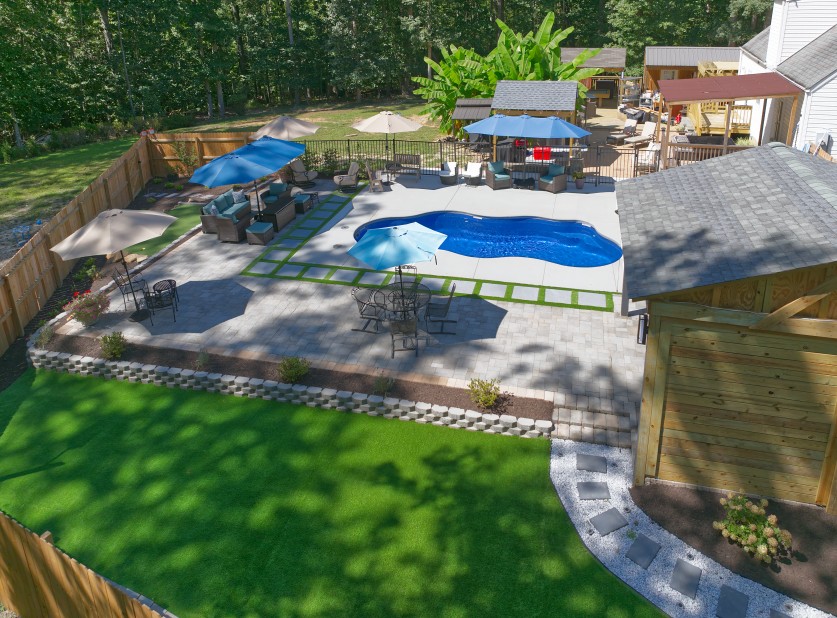
Fiberglass Pool Cost
On average, fiberglass pools cost around $55,000 and $130,000 installed. This includes the excavation, shell, electrical, plumbing, and basic decking. Of course costs will rise if you go for a premium shell size or finish, use upgraded equipment, or if the site conditions are complex for installation.
That said, fiberglass pools require far less chemical spending and long-term maintenance over their lifetime. You can expect to save somewhere between $1,500 and $3,000 per year in maintenance costs compared to concrete.
In addition, if you choose the right fiberglass manufacturer, the gelcoat can come with a lifetime warranty which does not require the $10,000 to $30,000+ refinishing with gunite pools.
A win win!
Fiberglass Pools Pros
- These pools have a smooth, non-porous gelcoat surface that is algae-resistant and it dramatically reduces the chemical usage and cleaning frequency. This lowers their lifetime cost (compared to gunite) when factoring in chemical savings, reduced cleaning time, and no resurfacing requirement.
- They have the fastest installation of any inground pool. Most builds complete in three to eight weeks from excavation to filling up.
- Fiberglass pools are comfortable underfoot and gentle on swimwear, making them ideal for families with young children.
- Their composite shell flexes slightly with ground movement rather than cracking under pressure, making them exceptionally durable.
- You can select built-in features like tanning ledges, benches, and step systems directly into the shell.
- There are no variables involved. As in, you’ll get consistent quality, from factory to the ground, because contingencies involving on-site construction crews won’t be as critical.
Fiberglass Pools Cons
- You can only choose from the manufacturer's limited available mold catalog because these pools cannot be fully customized.
- Size is constrained by transportability. Most shells max out around 16 by 40 feet due to highway width shipping restrictions.
- Gelcoat can be prone to fading, chalking, or developing osmotic blisters, depending on the fiberglass manufacturer you choose. The good news is that modern manufacturing has made these issues much less common than they once were.
- Higher upfront cost than vinyl liner pools, which offer a comparable installation timeline at lower initial price.
- Access to the installation site must accommodate a crane and delivery truck, which can be a challenge on tight lots.
Who Fiberglass Is Best For
Fiberglass is the ideal choice for you if you want the best balance of quality, low maintenance, and fast installation. It suits families who want a comfortable, easy-to-care-for pool without sacrificing durability. For customers that want a pool that is 16 by 40 feet or smaller, fiberglass is a great choice.
If you’re comfortable choosing from the available shell designs and want to be swimming within two months of excavation, fiberglass is perhaps your best bet.
Vinyl Liner Pools – Lowest Upfront Cost
Vinyl liner pools are the most accessible entry point into inground pool ownership. They come with a structural frame made of either steel, polymer, or aluminum that supports a custom-fitted vinyl liner to hold the water.
While they do require periodic liner replacement and carry some long-term cost trade-offs, vinyl pools offer great flexibility in shape. They’re also particularly popular in colder climates where freeze-thaw cycles are a concern.
How Vinyl Liner Pools Are Built
Installing a vinyl liner pool involves excavation followed by installation of a structural framework – typically steel panels, polymer walls, or aluminum – set into the ground to form the pool’s shape.
Then, a sand or vermiculite base is poured and smoothed on the floor and a factory-manufactured vinyl liner, custom-cut to fit the pool’s exact dimensions, is hung from a track at the coping level.
After that, it is vacuum-fitted tightly against the walls and floor before water fills the pool. This installation process will typically take four to eight weeks.


Vinyl Liner Pool Cost
Vinyl liner pools are the most affordable inground option, typically ranging from $40,000 and $90,000 installed. However, the liner itself must be replaced every 7 to 10 years at a cost of $3,000 to $6,000 per replacement. This is a recurring expense that narrows the lifetime cost advantage over fiberglass.
Vinyl Liner Pools Pros
- These pools have the lowest upfront cost of any inground pool type, making pool ownership accessible for more homeowners.
- It has a smooth, non-abrasive liner surface that’s comfortable underfoot and gentle on swimmers.
- Vinyl pools have more shape flexibility than fiberglass since the structural frame can be built to custom dimensions beyond standard mold sizes. If you customize greatly, then the cost advantages can disappear when compared to fiberglass.
- Liners are available in dozens of patterns, colors, and textures and you can play with the aesthetics as much as you like.
- These pools make a smart choice for cold-weather climate because steel and polymer wall panels are built to flex with freeze-thaw cycles
Vinyl Liner Pools Cons
- Vinyl liners have to be replaced every 7 to 10 years, adding $3,000 to $6,000 in recurring costs over the pool’s lifetime.
- It’s vulnerable to punctures, tears, and damage from sharp objects, pool toys, or improper chemical balance. Plus liner seams at corners, steps, and fittings are potential weak points where leaks can develop over time.
- They have a lower resale value compared to gunite or fiberglass because buyers view liner replacement as a near-term expense.
- You have limited depth capabilities since very deep or elaborate shapes can be difficult to liner correctly without seaming issues.
- Underground water conditions can impact the liner, causing wrinkles in the liner over time.
Who Vinyl Liner Is Best For
Vinyl liner pools are the right fit for you if you’re working with a tight upfront budget, planning to sell within a few years, or located in climates with harsh winters.
They’re also a practical choice for buyers who want a larger or more customized footprint than fiberglass molds allow, without committing to the full cost of gunite construction.
Choose the Right Pool Type for Your Backyard
Schedule a free consultation to discuss our options with our team. No pressure, just honest guidance.
Gunite vs. Fiberglass vs. Vinyl: Which Is Best?
No pool type can win on every dimension. Here’s a head-to-head comparison that covers factors that matter most so you can see exactly where each type leads and where it falls short.
| Factor | Gunite | Fiberglass | Vinyl |
|---|---|---|---|
| Upfront Cost | $50,000 to $200,000 | $55,000 to $130,000 | $40,000 to $90,000 |
| Lifetime Cost | High, for resurfacing every 10 to 25 years plus higher chemical costs | Lowest, for practically no resurfacing, fewer chemicals | Moderate, for liner replacement |
| Installation Time | 3 to 6 months | 4 to 8 weeks | 4 to 8 weeks |
| Lifespan | 50+ years with resurfacing | 25 to 50+ depending on manufacturer | 20 to 30 years (liner: 7 to 10 years) |
| Design Flexibility | Unlimited; any shape, size, or depth | Limited to manufacturer mold catalog | High; custom frame shapes possible |
| Luxury Features | Full range, can add vanishing edges, grottos, raised spas, fire features | Good, can install built-in ledges, raised spas and benches standard | Limited, complex features are difficult to integrate |
| Maintenance | High. Porous surface requires more chemicals and cleaning | Low. Non-porous gelcoat resists algae | Moderate. Liner requires careful chemical balance |
| Durability | Excellent, has a rigid concrete shell | Very good, has a composite shell flexes with ground movement | Good, though liner is vulnerable to punctures and tears |
| Is resurfacing needed? | Yes, every 10 to 25 years ($10,000 to $30,000+) | No | Liner replacement every 7 to 10 years |
| Resale Value | Highest | High | Low to moderate |
| Best for? | Long-term owners, luxury builds, custom designs | Low maintenance, fast install, family pools | Budget-conscious buyers, cold climates, shorter timelines |
Let Us Help You Decide
We’ll walk your property and give you honest recommendations on which type fits best.
Which Inground Pool Type Should You Choose?
The best pool type for you depends on your location, preferences, and specific situation. Factors to consider include:
- Your budget
- How long you’ll be in your home
- How much maintenance you’re willing to do
- How important design customization is to you should all factor into this decision
If you want a custom design, showpiece backyard, gunite always makes financial and aesthetic sense. The upfront premium pays off in longevity, design quality, and property value.
If you want great value, have a yard that suits a 16 by 40 foot pool or smaller, want less short and long-term maintenance, fiberglass is the great choice. You’ll have lower chemical costs and no resurfacing bills, which add up to real savings.
If your budget is the primary driver or you’re not sure how long you’ll stay, vinyl liner gives you a quality inground pool at a very low price point.
A bottom line (and the truth)? All three types of inground pools can serve you well. The decision comes down to matching the right type to your priorities. Here, use these breakdowns below to make the call with confidence.
Choose Gunite If…
- Your design vision requires a custom shape, depth, or layout no mold can achieve
- You want a vanishing edge, grotto, elevated spa, or other complex luxury feature
- Resale value and curb appeal are a priority for your property
- Your lot has access challenges, steep slopes, or unusual conditions that limit prefab delivery
- Budget is flexible and you’re building a “forever pool” from the start
Choose Fiberglass If…
- You want to be swimming as quickly as possible because fiberglass installation is faster
- Minimizing ongoing maintenance time and chemical costs is a top priority
- You have young children who’ll benefit from the smooth, comfortable surface
- A shell from the manufacturer’s catalog fits your size and shape requirements
- You want the best long-term value without paying gunite’s premium upfront cost
- Your lot has adequate crane and delivery truck access for shell installation
Choose Vinyl Liner If…
- Upfront affordability is the primary constraint and you need to minimize initial cost
- You live in a cold climate where freeze-thaw flexibility is a structural concern
- You want a larger or more uniquely shaped pool than fiberglass molds allow at this budget
- You expect to sell your home within five to seven years before lifetime costs accumulate
- You’re comfortable planning for liner replacement as part of long-term ownership costs
FAQs
Which inground pool lasts the longest?
Gunite pools last the longest, 50 years or more with proper maintenance and periodic resurfacing.
Which type of pool is easiest to maintain?
Fiberglass pools are easiest to maintain by a clear margin. The non-porous gelcoat surface resists algae growth and requires significantly fewer chemicals than gunite. Plus there are no refinishing costs or liner replacement costs long-term.
Which pool type adds the most home value?
Gunite pools typically add the most resale value, particularly for luxury properties where buyers expect premium outdoor living features.
Which inground pool type is cheapest?
Vinyl liner pools have the lowest upfront cost, typically costing $40,000 to $90,000 installed. However, when accounting for liner replacements over 20 to 30 years, fiberglass can be cheaper in the long run despite higher initial pricing.
What’s the most popular type of inground pool?
Gunite remains the most commonly installed type nationally, especially in warm-climate states across the Southeast and Southwest. Fiberglass has gained significant market share over the past decade and is a close second due to faster installation and lower maintenance. Vinyl liner pools dominate in the Midwest and Northeast where cold climates favor their flexible construction.
What’s the fastest pool to install?
Fiberglass and vinyl pools are the fastest, with most installations completing in three to eight weeks.
Can you add an infinity edge to a fiberglass pool?
True vanishing-edge infinity pools are generally not possible with standard fiberglass shells, as the mold determines the pool’s geometry.
Can you convert one pool type to another?
Converting between pool types is rarely easy or cost-effective. A vinyl liner pool can be resurfaced with a new liner, but converting to gunite typically requires demolishing the existing structure. Converting a gunite pool to fiberglass is not standard practice. It’s best to talk to a pool professional in detail before you pursue any conversion project.

Ready to Choose Your Pool Type?
We’ll help you decide between gunite, fiberglass, and vinyl based on your location, property, budget, and how long you plan to stay in your home. Schedule a free consultation to discuss your options with a pool group who’s building 1,100+ pools every year.
No obligation. No sales pitch. Just straightforward guidance on which pool makes sense for you.
| 1,100+ luxury inground pools built every year | Serving 11 cities across FL, VA, NC, SC, TX, AZ & CA
Choose the Right Pool Type for Your Backyard