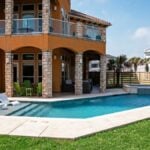
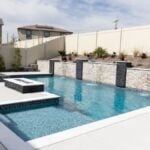
A pool with still, flat water doesn’t feel like a luxury backyard, even with perfect tile and a spotless deck. Water needs movement, sound, or light to feel expensive. That’s what a water feature does.
You’ve got 17 solid options below, sorted by what they’re actually good at: calm resort vibes, tanning ledge fun, high-energy movement, focal-point drama, or a view-stealing edge. Pick based on the job you want the water to do, not just what looks good in a photo.
First, Decide What You Want the Water Feature to Do
Before you pick a feature, get clear on the job. A water feature that looks stunning in a magazine can be the wrong choice for your yard if it doesn’t solve your actual problem.
Walk through these goals and see which ones match what you want:
- Add relaxing sound: something you can hear from the patio without it dominating conversation
- Create a luxury focal point: a feature people notice the moment they walk into the backyard
- Make a tanning ledge more useful: give kids and adults something to do in the shallow end
- Add movement to still water: break up a flat surface without a full waterfall
- Mask neighborhood noise: traffic, lawn equipment, or nearby pools
- Connect the pool with a spa: blend the two into one visual system
- Make the pool look better at night: lighting-driven drama after sunset
- Entertain kids or guests: interactive, playful, built for activity
Most homeowners want two or three of these at once. That’s fine. Just don’t try to hit all eight with a single feature. That’s how you end up with something that looks busy instead of luxury.
Best Water Features for a Calm, Resort-Style Pool

These features add sound and movement without shouting for attention. They’re the right call if you want your pool to feel like a quiet retreat, not a water park.
1. Sheer Descent Waterfall
A sheer descent sends a thin, even sheet of water off a raised wall, like a pane of glass sliding into the pool. It’s the cleanest option for modern, geometric pools.
The sound is soft, more white noise than splash. Most sheer descents run $3,000 to $10,000 installed, depending on width and wall finish. Glass tile or stacked stone on the wall face pushes cost toward the higher end.
2. Rain Curtain
A rain curtain drops individual droplets from an elevated structure, mimicking a warm summer shower. It needs height, 6 to 8 feet, to keep its shape, so it’s usually suspended from a pergola or pavilion rather than a low wall.
Sheer sheets break apart in wind above 3 to 4 feet, which is why rain curtains take over at greater heights. A professionally installed rain curtain starts around $4,000 to $6,000 for a narrow structure and can run $8,000 to $12,000 or more for a wider, fully custom frame. Budget for roughly 8 gallons per minute of flow for every linear foot of width.
3. Wall Scuppers
Scuppers are wall-mounted spouts that pour water in a narrow stream, usually installed in sets of three for rhythm. Finish options include copper, stainless steel, and cast stone, so they read as architecture, not just plumbing.
Expect $2,500 to $6,000 each installed. Scuppers pair well with formal pool designs where you want a repeated, sculptural detail rather than one big statement.
4. Spillover Spa
A spillover spa raises the spa above the pool and lets water cascade continuously over the shared wall. You get constant movement and sound without adding a separate pump, since the spa’s existing equipment does the work.
This is one of the most efficient water features you can buy. If you’re already building a spa, adding the spillover edge is a small cost bump for a big visual return.
Find the Right Water Feature for Your Pool
Choose a feature that fits your pool, backyard, budget, and the experience you want to create.
Best Water Features for Tanning Ledges and Shallow Areas

If your pool has a tanning ledge or sun shelf, these features turn dead space into the part of the pool everyone gathers around.
5. Pool Bubblers
Bubblers push a low column of water straight up through the surface, usually spaced across a tanning ledge. They’re one of the more affordable built-in features, roughly $500 to $1,500 each, and they double as a play zone for kids.
Because they’re low and gentle, bubblers work even on a shelf where people are lounging in chairs or on floats.
6. Lighted Bubblers
Same feature, with an LED light built into the base. During the day they look identical to standard bubblers. After dark, they turn the shallow end into the visual centerpiece of the yard.
The lighting kit adds modestly to the base bubbler cost. If you’re already running electrical for pool lighting, bundling it in during construction keeps the add-on cheap.
7. Small Fountain Jets on a Sun Shelf
These are taller than bubblers (a narrow arc or column instead of a gentle bubble) placed along the edge of a sun shelf. They give the shelf more visual energy without turning it into a splash zone.
Good middle ground if bubblers feel too subtle but you’re not ready for full deck jets.
Best Water Features for Energy and Movement

Want your pool to feel alive even when nobody’s swimming? These features add constant motion and sound.
8. Deck Jets
Deck jets shoot arcing streams of water from the deck into the pool, usually in sets of two to four at the corners of a rectangular pool. They’re one of the most affordable ways to add movement, roughly $500 to $1,000 per jet installed.
Arcs typically reach 4 to 5 feet. Kids love playing in the stream, and the steady sound changes the whole feel of the yard.
9. Laminar Jets
A laminar is the upgraded version of a deck jet, a thicker, glass-like stream that holds its shape 6 to 8 feet in the air, often lit from inside with LEDs. The tradeoff is cost: $2,500 to $5,000 per jet, versus a few hundred for a standard deck jet.
Laminars are sensitive to wind. Anything over 5 mph can break up the stream, so a lot of installs include a wind sensor that shuts the jets off automatically.
10. Pool Fountain Jets
These are larger, freestanding fountain-style jets set in the pool itself rather than along the deck edge, a vertical column of water that acts as a centerpiece. Pricing spans a wide range, from a few hundred dollars for a simple nozzle to $8,000 for a custom multi-jet display.
Fountain jets work best in larger pools where there’s room for the water to be the focal point without crowding swimmers.
Add More Movement to Your Pool
Explore water features that bring sound, motion, and energy to your backyard without overwhelming the design.
Best Water Features for a Luxury Focal Point

Some features aren’t about sound or play, they’re about giving the backyard a single striking element that anchors the whole design.
11. Raised Wall With Water Feature
A raised wall combines structure with water, usually a sheer descent, scupper, or spillway built into a taller feature wall that also gives you privacy or a planting bed. It’s a moderate-complexity build since you’re adding both hardscape and plumbing.
This is the feature to pick if you want height and drama without going all the way to a rock waterfall.
12. Fire and Water Bowls
Fire bowls with a water spillway combine flame and flowing water in one fixture, usually set on a raised wall or pedestal. Entry-level concrete or steel bowls run $1,000 to $1,500 installed. Mid-range GFRC bowls with electronic ignition land around $2,000 to $3,500, and high-end copper or fully automated combo units can hit $4,000 to $10,000.
Combo units cost more to install because you’re running both a gas line and a water line to the same fixture.
13. Natural Rock Waterfall
A natural rock waterfall is the biggest statement on this list, real or faux boulders stacked into a cascade, often with a grotto behind it. These start around $15,000 and can reach $30,000 depending on scale.
They need room to look right. A quarter acre or more of yard behind the pool gives the structure space to breathe. On a small lot, a scaled-down rock feature usually looks cramped instead of natural.
14. Tile Feature Wall With Water Spillway
This is a sheer descent or spillway built into a wall finished entirely in glass or ceramic tile instead of stone. The tile face is what pushes this into focal-point territory; it catches light and color in a way plain stucco can’t.
Cost runs similar to a standard sheer descent, plus the tile upgrade, which depends heavily on the tile you choose.
Best Water Features for Views and High-End Custom Pools

If your lot has a view, a golf course, treeline, or water, these features are built to disappear into it.
15. Infinity Edge
An infinity edge lets water spill over one side of the pool into a hidden catch basin, creating the illusion that the pool has no boundary. It needs a natural slope or elevated site to work, since the drop is what sells the effect.
Adding an infinity edge typically adds $20,000 to $50,000 to base construction costs, on top of the pool itself.
16. Perimeter Overflow Edge
Also called a zero-edge or knife-edge pool, this design lets water overflow on all four sides into a channel that runs the full perimeter. The surface sits flush with the deck, creating a mirror-flat look from every angle.
It’s the most expensive water feature on this list, often adding $40,000 to $100,000 or more to base construction, because you need a full perimeter catch basin, a bigger pump, and precise leveling on all sides.
17. Slot Overflow Detail
A slot overflow is a refinement of the perimeter overflow: instead of a visible grate around the edge, the overflow channel is hidden inside a narrow slot built into the deck material. It’s the detail that separates a good perimeter overflow pool from a great one.
Cost runs in the same range as a standard perimeter overflow, with the difference coming down to the mason’s skill at integrating the slot cleanly into the deck.
Design a Pool With the Right Water Feature
Get expert help choosing the feature that fits your goals, space, and overall pool design.
How to Choose the Right Pool Water Feature
Match your goal to a feature using this table, and check the tradeoff before you commit.
| If you want… | Best feature | Why it works | Watch out for |
|---|---|---|---|
| Soft sound | Sheer descent or scuppers | Quiet, steady sound that doesn’t overpower conversation | Wind can distort a sheer sheet above 3-4 ft |
| Kid-friendly movement | Bubblers or deck jets | Low cost, safe for shallow water and active play | Nozzles clog easily with debris, needs a dedicated inline filter |
| Luxury night effect | Lighted bubblers or laminar jets | LED lighting turns the feature into the yard’s centerpiece after dark | Laminar jets need a wind sensor or the stream breaks apart |
| Modern focal point | Raised wall with spillway | Combines structure and water in one striking element | Needs a stable footing and adds to the hardscape budget |
| Natural look | Rock waterfall | Anchors the whole backyard, works well on larger lots | Needs a quarter acre or more to look proportional, not cramped |
| View-focused design | Infinity edge | Blends the pool into a view of a slope, golf course, or water | Only works on sloped or elevated sites |
| Spa-like feel | Spillover spa | Continuous movement using equipment you already have for the spa | Only useful if you’re building a spa alongside the pool |
| Quiet elegance | Slot overflow | Seamless, mirror-flat look with no visible hardware | Highest cost on this list, needs a skilled mason |
How Water Feature Costs Scale With Complexity
Cost is part of this decision whether you plan around it or not. Here’s how the 17 features break down by complexity.
- Lower complexity ($500 to $1,500 each): Bubblers, simple deck jets. Minimal plumbing, work off the pool’s main pump, no extra structure.
- Moderate complexity ($2,500 to $10,000): Scuppers, sheer descents, raised wall spillways. These need a wall or elevated structure plus dedicated plumbing runs.
- Higher complexity ($1,000 to $30,000): Spillover spas, fire and water bowls, large waterfalls. These bring in extra utilities, gas lines, bigger pumps, or a full spa system, and more site work.
- Premium complexity ($20,000 to $100,000+): Infinity edges, perimeter overflow, custom slot overflow. These require a catch basin, dedicated recirculation pump, and precise structural engineering, which is why the cost jumps sharply.
What actually drives the price up: plumbing distance from the equipment pad, structural walls or elevation changes, dedicated pumps and filtration for the feature, lighting and automation, and finish materials like tile, copper, or natural stone. For a full breakdown of where your money goes on the base pool itself, see our inground pool cost guide.
The Best Time to Add a Water Feature
Water features are cheapest and cleanest when they go in during a new build. The plumbing, structure, and equipment get planned into the pool from day one. What is even possible depends partly on your pool type, since a fiberglass shell limits where plumbing can be cut in.
Adding a feature to an existing pool later usually means cutting into the deck, running new underground plumbing back to the equipment pad, and possibly upgrading your pump to handle the extra flow. If the feature ties into a raised wall, you may need new footings too. Our installation process guide walks through how that sequencing works on a new build.
If you’re already planning a resurfacing project, that’s the cheapest time to add a feature, you’re opening up the deck and plumbing anyway. Check our pool resurfacing cost guide for bundled pricing. Adding a feature as a standalone retrofit later typically costs 30% to 50% more than the same feature added during construction or resurfacing.
Water Feature Mistakes That Make a Pool Feel Less Luxury
- Adding too many features: Three loud features fighting for attention reads as cluttered, not luxury. Pick one focal point and let it lead.
- Ignoring sound level: A rock waterfall next to your outdoor dining table can drown out conversation. Match the feature’s volume to how close it sits to living space.
- Choosing a feature that does not match the home: A natural rock grotto behind a sleek modern house looks out of place. Match the feature style to your architecture, not just the pool shape.
- Forgetting wind and splash: Laminar jets and rain curtains both lose their shape in wind, and splash can damage nearby decking or furniture over time.
- Not planning maintenance access: Every feature with a pump, nozzle, or light eventually needs service. If the equipment isn’t accessible, repairs get expensive fast.
Ready to add a water feature? The right feature comes down to the job you want the water to do, your budget, and whether you’re building new or retrofitting. If you’re still deciding, connect with your local team for a recommendation based on your pool, your yard, and your goals.
FAQs
What are the best water features for inground pools?
It depends on the job you want the water to do. Sheer descents and scuppers are best for calm sound, bubblers are best for tanning ledges, deck jets and laminars are best for energy, and infinity edges are best for a view.
Are pool water features worth it?
For resale and daily enjoyment, yes. A well-placed feature, even something as simple as deck jets, changes how the whole backyard feels without dramatically increasing your maintenance load.
Do water features add to pool maintenance or operating costs?
A little. Anything with its own pump, nozzle, or light needs occasional cleaning and part replacement, and larger features like waterfalls or infinity edges run a dedicated pump that adds modestly to your monthly electric bill. Bubblers and deck jets add the least; perimeter overflow systems add the most.
What is the cheapest pool water feature?
Bubblers and basic deck jets are typically the least expensive built-in options, often $500 to $1,500 installed.
What pool water feature looks most luxury?
Perimeter overflow and slot overflow edges deliver the most dramatic, high-end look, since the water appears to have no visible edge or hardware at all.
Do pool water features need extra pumps?
Small features like bubblers and deck jets can often run off your main pool pump. Larger features (spillover spas, waterfalls, infinity edges, and perimeter overflow systems) usually need a dedicated pump to keep flow and pressure consistent.
Ready to Elevate Your Pool?
Get expert guidance on the right water feature, design, and budget for your backyard.