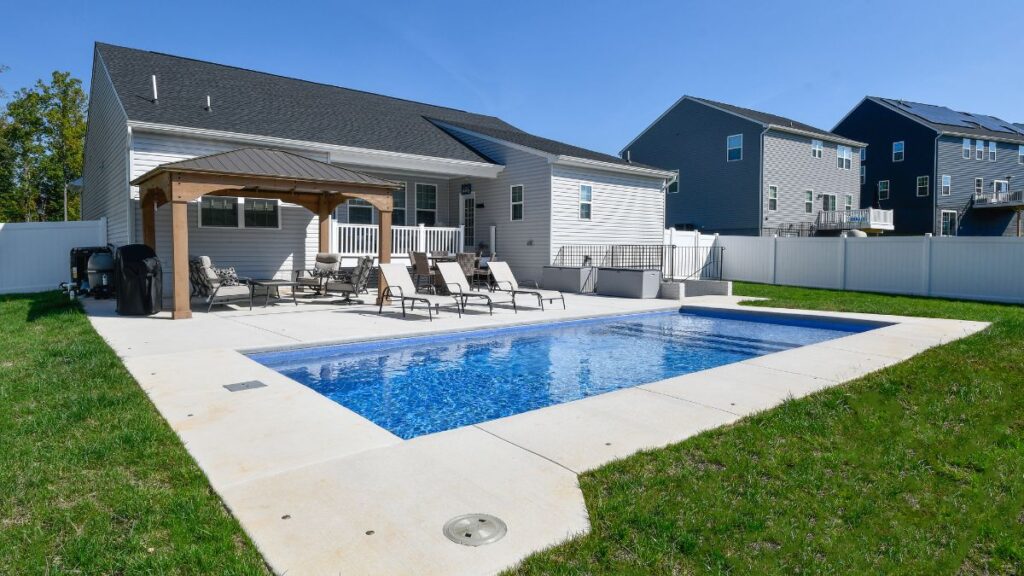
Neither a saltwater pool nor a chlorine pool is universally better. Both systems keep your pool clean, clear, and safe when properly maintained, so the right choice really depends on your budget and how much maintenance you want to deal with.
Quick Answer: Saltwater vs. Chlorine Pool
If you’re choosing between a saltwater pool and a chlorine pool, the right option comes down to your budget and how much maintenance you want to handle.
A saltwater pool produces its own chlorine for easier day-to-day care, while a chlorine pool costs less to install but requires regular chemical additions.
If you want softer-feeling water and less hands-on maintenance, a saltwater pool is a smart long-term investment. But if keeping installation costs low is your main priority, a traditional chlorine pool is a dependable and cost-effective choice.
| Feature | Saltwater Pool | Chlorine Pool |
|---|---|---|
| Upfront cost | $2,500 to $3,500 more for the salt chlorine generator | $0 to $500, uses standard pool equipment already included in most builds |
| Ongoing maintenance | Less manual chlorine handling | More frequent chemical additions |
| Water feel | Softer and gentler | Can feel harsher if chemistry is off |
| Chlorine source | Generated from dissolved salt | Added manually |
| Chemical odor | Less noticeable | More noticeable if chloramines build up |
| Equipment | Salt chlorinator plus pool equipment | Standard pool equipment |
| Long-term costs | Salt cell replacement adds expense | Regular chlorine purchases add up over time |
| Best For | Homeowners who want easier routine care and softer water | Buyers focused on a lower installation budget |
How Saltwater Pools Actually Work
A saltwater pool has salt dissolved in the water and a salt chlorine generator installed as part of the filtration system. The generator uses electrolysis to convert dissolved salt into chlorine, which sanitizes the water and helps control algae and bacteria.
Saltwater pools still use chlorine. They make chlorine rather than relying solely on tablets, liquid chlorine, or granules. This means you’ll spend less time adding sanitizer by hand, but you’ll still need to test the water and keep the system clean so it continues producing the right amount of chlorine.
How Traditional Chlorine Pools Work
A traditional chlorine pool stays clean by adding chlorine manually through tablets, liquid chlorine, granules, or automatic feeder systems. The chlorine kills bacteria, algae, and other contaminants, but it must be replenished regularly to maintain proper sanitizer levels.
You’ll also need to test the water often and adjust the pH, alkalinity, and chlorine levels to keep everything balanced. Occasional pool shocking is part of the routine because it removes built-up contaminants and restores the chlorine’s ability to sanitize the water effectively.
Saltwater vs. Chlorine Pool Cost
The biggest cost difference is the upfront investment. A saltwater pool costs $2,500 to $3,500 more because it needs a salt chlorine generator, while a traditional chlorine pool uses simpler equipment that’s already part of a standard build.
A saltwater pool softens the water to the touch and lowers your chlorine costs, but you’ll still need other pool chemicals and will eventually replace the salt cell. A chlorine pool has lower equipment costs, but you’ll spend more on chlorine over time, so long-term costs are closer than many homeowners expect.
| Cost Item | Saltwater Pool | Chlorine Pool |
|---|---|---|
| Initial setup | $2,500 to $3,500 for the salt chlorine generator | $0 to $500, uses standard pool equipment already included in most builds |
| Annual chemicals | $100 to $300 per year for salt, pH, alkalinity, and stabilizer products | $300 to $800 per year for chlorine and balancing chemicals |
| Electricity | Roughly $20 to $50 more per year from continuous generator operation | No added electrical cost |
| Equipment replacement | Salt cell replacement every 3 to 6 years, $500 to $800 per cell | Fewer specialized parts to replace |
| Other long-term costs | Possible corrosion-related wear on metal fixtures and finishes | Minimal added wear from the sanitizing system itself |
| Service complexity | The salt system requires periodic cell inspection and cleaning | Simpler equipment with straightforward maintenance |
Wondering What Saltwater Really Costs Long-Term?
Compare saltwater and chlorine based on your budget, maintenance, and backyard goals.
Maintenance Differences
A saltwater pool can reduce the amount of manual chlorine you add, but it is not maintenance-free. You still need to test and balance the chlorine level, pH, alkalinity, calcium hardness, stabilizer, and salt level to keep the water clean and protect your equipment.
A chlorine pool requires regular chlorine additions, while a saltwater pool needs periodic salt-cell inspections and cleaning to keep the salt cells producing chlorine. Both pool types should be shocked when needed to remove built-up contaminants and restore proper water quality.
Water Feel, Skin, Eyes, and Chlorine Smell
If comfort is high on your list, a saltwater pool has the advantage because the water feels softer and leaves your skin feeling less dry. It also tends to have less of the strong “pool smell,” making swimming more enjoyable for many homeowners and guests.
Keep in mind that poor water chemistry can irritate your skin and eyes in both saltwater and chlorine pools if the water isn’t properly balanced. That strong chlorine smell most people notice is caused by chloramines, not clean, properly balanced free chlorine, so regular testing and maintenance are the best way to keep the water comfortable.
Equipment, Corrosion, and Material Concerns
Your sanitizer system affects more than just the water. If you’re building out a backyard with travertine, natural stone, water features, metal fixtures, or an outdoor kitchen, you’ll want materials that play nice with your pool system.
Saltwater pools can speed up corrosion if the water’s out of balance or the wrong materials are used nearby. Salt can also take a toll on stone, metal fixtures, patio furniture, and outdoor appliances over time. A chlorine pool skips that issue entirely, since it doesn’t expose those materials to salt, which makes material selection a lot more straightforward.
Saltwater vs. Chlorine for Different Pool Types
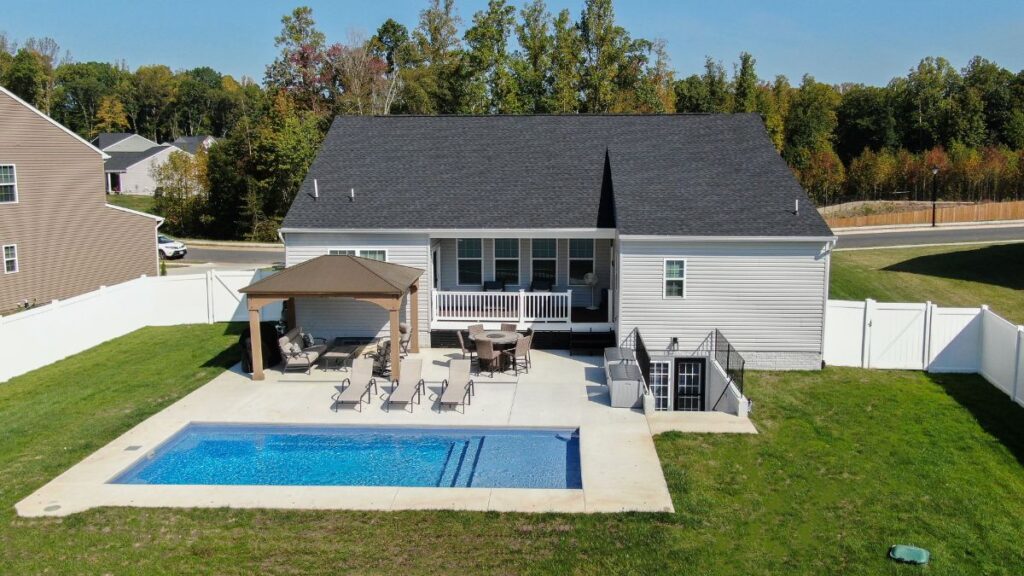
The best sanitizer system isn’t just about maintenance or cost. It should also match the type of pool you’re building so your equipment, finish, and water stay in good condition for years.
Gunite Pools
Gunite pools work well with both saltwater and chlorine systems because they’re built for long-term durability. The right choice comes down to the level of maintenance you want and the materials used around the pool.
If you go with saltwater, protect your natural stone, metal fixtures, and water features by sticking to salt-compatible materials and keeping your water chemistry balanced. A chlorine system gives you more flexibility with surrounding materials, so it’s a good fit if you’d rather keep the equipment setup simple.
Fiberglass Pools
Fiberglass pools pair well with both sanitizer systems because their smooth surfaces resist algae and are easy to clean. Many homeowners choose saltwater because the softer-feeling water complements the smooth fiberglass finish.
A saltwater system still requires regular water testing and salt cell maintenance to protect the equipment. A chlorine system costs less to install and keeps the pool just as clean with routine chemical care.
Vinyl Liner Pools
Vinyl liner pools can use either saltwater or chlorine without affecting everyday performance when the water stays properly balanced. The liner itself isn’t damaged by salt, but poor water chemistry can shorten its lifespan.
If you install a saltwater system, make sure all metal components are compatible with saltwater to reduce corrosion. A chlorine system is a practical choice if you want lower upfront equipment costs and straightforward maintenance.
Saltwater vs. Chlorine Pools by Region
Florida: Long swimming seasons, hot weather, and strong sun use up chlorine faster in either system, so regular water testing matters year-round. High humidity also speeds up corrosion on metal fixtures near a saltwater pool, so protecting those materials is especially important here.
Virginia and North Carolina: Winterizing matters more here than in almost any other market we serve. If you’ve got a saltwater system, the salt cell needs to come out or be properly protected before freezing temperatures hit because a cell that freezes with water still inside can crack. Chlorine pools are simpler to winterize since there’s no cell to worry about, just standard equipment draining and plumbing antifreeze.
South Carolina: Warm weather and a long swimming season mean chlorine burns off faster in direct sun for both systems. Humidity along the South Carolina coast adds to the corrosion risk saltwater systems already carry, so salt-compatible fixtures are worth the upfront cost here.
Texas: Hot, sunny summers across Corpus Christi, San Antonio, Austin, and Houston mean both systems need more frequent monitoring during peak season. Hard water in parts of the state can also affect salt cell scaling, so periodic cell cleaning matters more here than in areas with softer water.
Arizona and California: Intense sun and heat in Phoenix increase chlorine demand and salt cell workload alike, so both systems need closer attention in summer. Coastal humidity in Temecula and San Diego carries some of the same corrosion considerations as Gulf Coast and Southeast markets.
Which Pool System Should You Choose?
Both systems can keep your pool clean and safe when they are properly maintained. The best choice comes down to your budget, maintenance preferences, and the type of pool and backyard you’re building.
Choose saltwater if:
- You want to add chlorine less often
- You prefer water that feels softer on your skin and eyes
- You are comfortable maintaining a salt chlorine generator and cleaning the salt cell
- You are building with salt-compatible materials and equipment
- You plan to keep the pool for many years and don’t mind the higher upfront cost
Choose chlorine if:
- You want a lower installation cost
- You prefer a simpler equipment setup
- You don’t mind adding chlorine as part of regular pool maintenance
- You’re building a pool with materials that aren’t ideal for saltwater exposure
- You want a straightforward system that’s easy to repair and upgrade
Get Expert Guidance Before You Build
Your local experts will help you choose the best sanitation system for your pool, lifestyle, and long-term maintenance goals.
Common Myths About Saltwater and Chlorine Pools
There’s a lot of misinformation about saltwater and chlorine pools. Knowing the facts will help you choose the right system and avoid unrealistic expectations.
Myth: Saltwater pools are chlorine-free. Fact: Saltwater pools still use chlorine. The salt chlorine generator produces chlorine from dissolved salt rather than relying on tablets, liquid chlorine, or granules.
Myth: Saltwater pools require no maintenance. Fact: Saltwater pools still need regular water testing, balancing, salt cell cleaning, and occasional shocking when needed.
Myth: Saltwater tastes like ocean water. Fact: No. Saltwater pools contain far less salt than the ocean, so the water has only a mild salty taste.
Myth: Saltwater pools never get algae. Fact: Algae can grow in any pool if chlorine levels or water chemistry aren’t properly maintained.
Myth: Chlorine pools always smell bad. Fact: A strong pool smell is usually caused by chloramines, not properly balanced free chlorine. A clean, well-maintained chlorine pool should have very little odor.
Myth: Saltwater pools don’t need pH adjustment. Fact: Saltwater generators naturally push pH upward over time as a byproduct of the electrolysis process. Saltwater pool owners need to add pH-reducing chemicals more regularly than chlorine pool owners, not less.
Still deciding between saltwater and chlorine for your build? Schedule a free consultation with your local team to talk through what fits your pool type, budget, and maintenance preferences.
FAQs
How often does a salt cell need replacement?
Most salt cells last about 3 to 6 years with proper care. Cleaning the cell and maintaining balanced water can help extend its lifespan.
Does a saltwater pool really cost more over time than chlorine?
Not by as much as the upfront price difference suggests. A saltwater system costs $2,500 to $3,500 more to install, but chlorine runs $300 to $800 a year versus $100 to $300 for saltwater. Factor in a $500 to $800 salt cell replacement every few years, and the two systems end up within a few hundred dollars of each other over five years.
Can I have a saltwater pool in a cold climate?
Yes, but the salt cell needs to be removed or properly protected before winter. A cell that freezes with water still inside it can crack, which means an unplanned replacement. In Virginia, North Carolina, and Tennessee, factor proper winterizing into your annual maintenance routine either way.
Does a saltwater pool need more pH adjustment than a chlorine pool?
Often, yes. The electrolysis process that makes chlorine from salt also raises pH over time, so saltwater pool owners add pH-reducing chemicals more frequently than chlorine pool owners realize going in.
Is a saltwater pool safer for pets than a chlorine pool?
Saltwater is generally gentler on a pet’s skin, coat, and eyes than a heavily chlorinated pool. That said, pets that drink pool water regularly should still have fresh water available too, and any pool chemical, salt or chlorine, should stay balanced and stored safely.
Can a chlorine pool be converted to a saltwater pool?
Yes, in most cases. A licensed professional installs a salt chlorine generator and adds the right amount of pool salt. Just make sure your fixtures and equipment can actually handle the new system first. Some materials may need upgrading, and your electrical bonding and grounding may need a review as part of the conversion.
Ready to Choose the Right Pool System?
Get expert help comparing saltwater and chlorine, plus a free, no-obligation estimate.